Do cyclists disregard ‘priority-to-the-right’ more often than motorists?

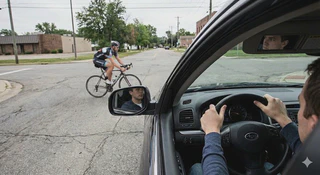 (This image is generated by AI)
Background
Do cyclists disregard traffic rules more often than motorists? Answering this is essential for optimizing traffic safety and efficiency as we transition toward autonomous driving in mixed environments. Grounded in naturalistic observations at urban unsignalized intersections, our study utilizes quasi-experimental methods and regression analysis to quantify compliance behaviors. This research is the result of a seamless collaboration between project managers, sensor technicians, data engineers, and human factors researchers, aiming to provide the critical behavioral data needed for safe human-machine coexistence.

Methods
Using stationary cameras, a 12-day naturalistic traffic observation was conducted at an urban T-intersection in Braunschweig, Germany. The video footage underwent spatial calibration to establish a real-world coordinate system. Road users were detected and classified, and their movements were converted into georeferenced trajectories. In 202 interaction cases, a car from the right (Ego, with priority) encountered a car or a bike from the left (Foe, without priority). The study examined how the following factors associated with the violation using logistic regression:
- Ego’s turning direction (left vs. right)
- Foe’s type (car vs. bike)
- Relative arrival time
- Foe’s lateral position
Key Findings
- Cyclists violated the “priority-to-the-right” rule more frequently than motorists.
- Road users with priority were more likely to yield when:
- turning right
- facing a bike
- arriving later at the intersection
- facing a road user close to the lane center
Conclusion
This study underscores the importance of implicit communication in mixed traffic. It provides empirical benchmarks for designing human-like autonomous driving systems, which is supposed to be capable of interpreting and responding to nuanced road-user interactions at unsignalized intersections.
